TRUST ME, I’M A DOCTOR: Reverend Hunter S. Thompson, the Missionaries of the New Truth, and the Downfall of the Biggest Hallucinogenic Drug Factory in the Mid-West

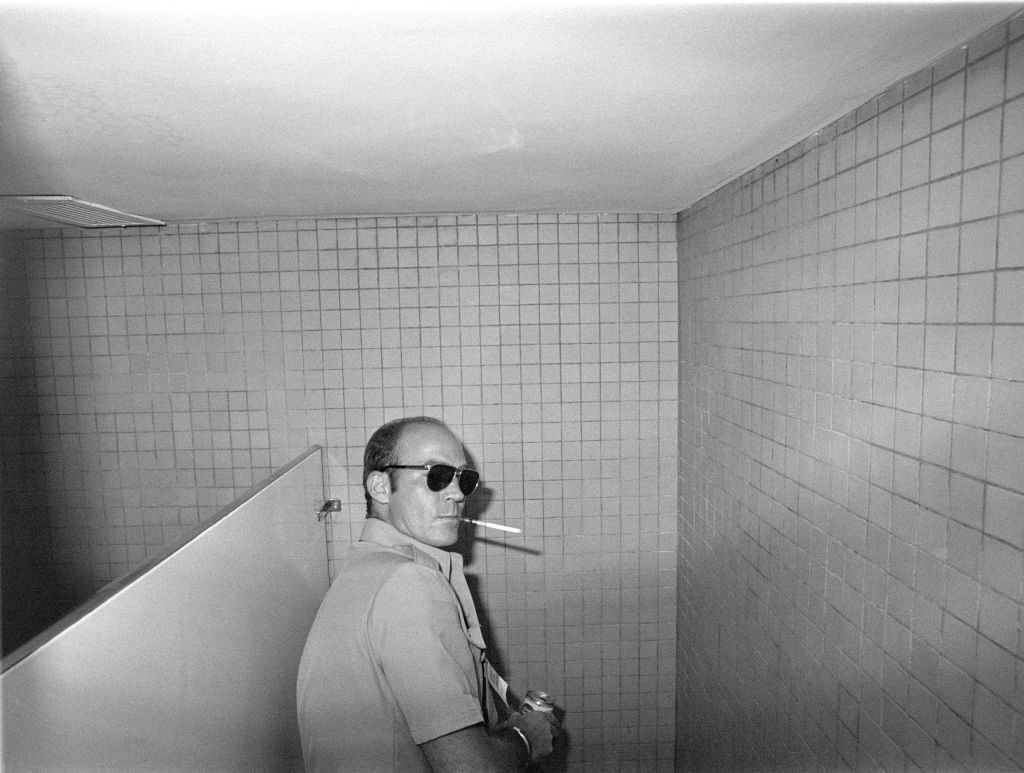
The Right Reverend Hunter Stockton Thompson, Doctor of Divinity, at the Democratic National Convention, NYC, July 15, 1976. (Credit: Brownie Harris/Corbis via Getty Images)

Hey guys,

I recently wrote an article for SPIN about Hunter and The Missionaries of the New Truth, the church where Hunter obtained his doctorate in divinity. See below for an excerpt and link to the full story over at Spin.com

– Rory

“Thompson had been officially conferred as a Doctor of Divinity by the church on July 10th, 1970 after a suggestion of his Wallposter collaborator and friend, Tom Benton, who later explained:

AT SOME POINT SOMEBODY HAD BOUGHT ME A SUBSCRIPTION TO THE LOS ANGELES FREE PRESS, AND EVERY WEEK I’D GET IT, AND THE BACK PAGE ALWAYS HAD THIS AD — “GET YOUR DOCTORATE OF DIVINITY DEGREE FOR $10” — SO I WENT TO HUNTER AND SAID, “LOOK MAN. WOULDN’T IT BE NICE IF WE CALLED OURSELVES “DR. THOMPSON” AND “DR. BENTON?” […] WE GOT THEM, AND HUNTER SAID, “THIS IS GREAT, BECAUSE YOU GET CUT RATES ON HOTELS. AND YOU KNOW, IT ALWAYS SOUNDS GOOD IN AN AIRPORT WHEN YOU HEAR ‘PAGING DR. THOMPSON.’” TOM BENTON, QUOTED IN “GONZO: THE LIFE OF HUNTER S. THOMPSON” BY COREY SEYMOUR AND JANN S. WENNER

Of course, it didn’t take long for Thompson to exercise his new ecclesiastical powers; he officiated a wedding with somewhat mixed results, with Thompson scaring the living daylights out of the bride-to-be courtesy of an electrotherapy device that he waved in her face, resulting in an electrical current arcing across from the gadget, hitting her on the nose. Afterwards he made a deal with Benton: “You do all the weddings and I’ll do all the funerals.”

Established in 1969 under the auspices of Frederick W. Zurndorfer and David A. Muncaster of Chicago, The Missionaries of the New Truth had first come to public attention in early 1970 when various reporters had profiled the church, having successfully purchased mail order doctorates. The articles focused mainly on the advantages of membership that were pushed heavily in the Church’s advertising, from tax benefits to discounts in hotels, theatres and transportation companies for members of the clergy. Another major claimed selling point was that ordained ministers could obtain privileges and exemptions from local, state, and federal governments and the armed forces, specifically the draft.

Writing for the Sun-Tattler in Hollywood, Florida, Arthur Rosett reported that according to B.L. David, then Hollywood city attorney — “There is nothing in the legal code of the state of Florida that prevents you from solemnizing marriages. After all, you are an ordained minister from a church recognised and incorporated under the laws of the state of Illinois. As for your other privileges, it sounds water-tight Reverend.”

Ecclesiastical figures were not so enthused by the Missionaries of the New Truth however, with Reverend Roy B. Connor D.D. of the First Presbyterian Church of Hollywood offering his view of the newfound Church – “I am aware that this goes on. My personal feeling is that it is of more interest and profitable to an individual than it is to the people of a community. However, it is perfectly legal and there is nothing we can do about it.”

As public interest in the Church grew, so too did opposition to its existence. In a June 1970 profile on the group in the Vermont press, Judge J. William O’ Brien was vehement in his condemnation: “There’s no question about it in my mind. There are some people behind this sort of thing who are out to destroy organized religion by setting up these cults. And this sort of thing will work to the detriment of sincere groups who want to start a different religion and have something to offer.” Scrutiny also began to fall upon the figures behind the Church itself. Though Frederich W. Zurndorfer was Dean of the Church, whose signature appeared on the issued doctoral certificates, alongside Archbishop A.M. Essary, the central figurehead and voice of the church was Archbishop David A. Muncaster. It was Muncaster who authored the official creed of the church, in which he outlined the central tenets by which members agreed to abide.    

“We believe in man as a seeker of Truth,” proclaims the creed. “We believe the nobility of man lies in the seeking of these truths. If a man is to live a meaningful, happy life, he must seek the truth.” As the Rev. George Lambert D.D., a fellow Truther, observed in his article for the Burlington Free Press, — “when it comes to procedure on seeking the Truth and just what constitutes ‘The Truth,’ Archbishop Muncaster begins to hedge.” 

“We believe that certain Truths all differ for each man, as each man is different […] for this reason we place no restrictions on man’s search for Truth except that he follow his best convictions with honesty and integrity. We thus exhort all our members to seek the Truth by all just means in any place and in any way they see fit.” Muncaster closed out the Creed with a simple declaration: “We pledge to keep our faith as free as possible from encumbering dogma and stultifying moral and social strictures.”
Click here to read the full story over at Spin

Book I contributed to wins two awards

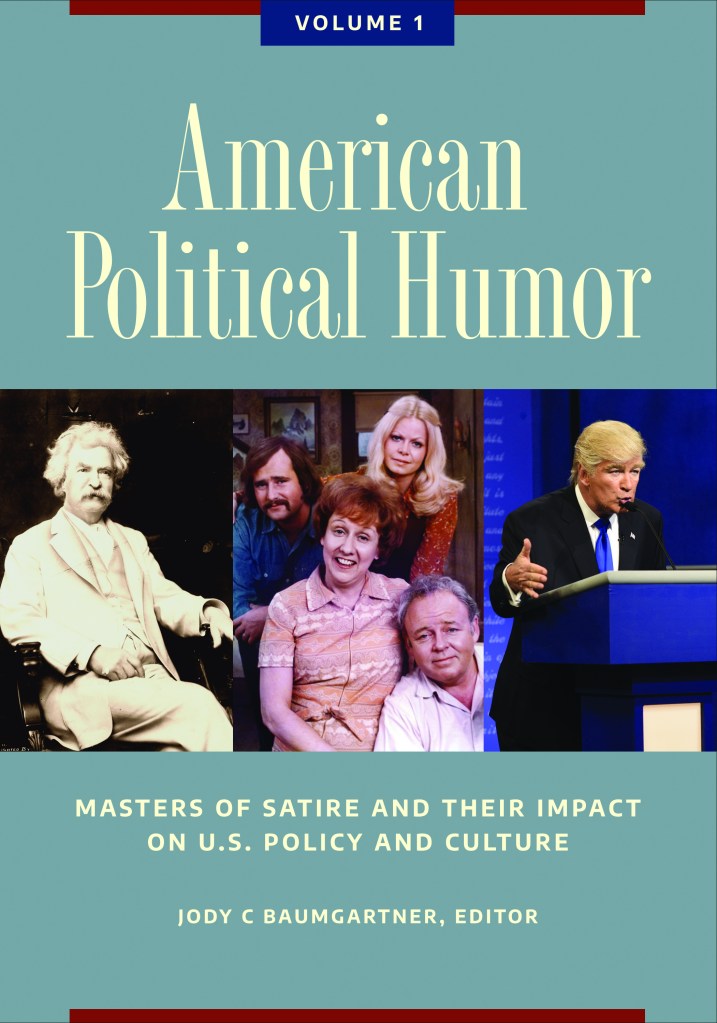
Just learned that a book I contributed to won two awards. American Political Humor: Masters of Satire and Their Impact on U.S. Policy and Culture was published last year and won the 2020 Outstanding Reference Source awarded by the Reference and User Services Association [RUSA] and also won Best Reference of 2019 awarded by Library Journal. I contributed the entry on Hunter S. Thompson.

Nice to hear and thanks again to Jody Baumgartner for including my essay on Hunter in the book.

Panel discussion on The Hell’s Angels Letters

I was delighted to participate in this two hour panel discussion on The Hell’s Angels Letters with some of the best experts out there on Hunter S. Thompson. Here’s the lowdown on all involved:

Margaret Harrell is hands on with Life. A dual national, she has lived and written in Morocco, Switzerland, and Belgium as well as the U.S.
The copy editor/assistant editor of Hell’s Angels and other remarkable books at Random House, she also was the international coordinator
of a museum project in Belgium. Now living in Raleigh NC, she is a longtime freelance book editor, a light body meditation teacher,
and a cloud photographer. She has thirteen published books, including the Keep This Quiet! memoir series.

Professor William McKeen is the author of eight books and the editor of four more, including Mile Marker Zero (Crown, 2011), a non-fiction narrative about Key West; Outlaw Journalist (W.W. Norton, 2008), a biography of Hunter S. Thompson; Highway 61 (W.W. Norton, 2003), a memoir of a 6,000-mile road trip with his teenage son; and two anthologies, Rock and Roll is Here to Stay (W. W. Norton, 2000) and Literary Journalism: A Reader (Wadsworth, 2000).

His most recent book is Everybody Had an Ocean (Chicago Review Press, 2017), about the intersection of music and crime in Los Angeles during the 1960s. It focuses on how Charles Manson was able to infiltrate the peace-love-and-flowers world of rock’n’roll royalty in Laurel Canyon, becoming a roommate to Dennis Wilson of the Beach Boys.

McKeen also produced an anthology about Florida, where he spent most of his life. Homegrown in Florida (University Press of Florida, 2012) celebrates childhood in the Sunshine State. In addition to writing two stories in the collection, McKeen gathered contributions from Carl Hiaasen, Michael Connelly, Kristin Harmel, Fabiola Santiago and Tom Petty.

His major teaching areas are literary journalism, history of journalism, reporting, feature writing and history of rock’n’roll.

Ron Whitehead is the founder of the Louisville Gonzo Fest. He is also the Beat Poet Laureate of Kentucky (2019‒2021) who received the City of Louisville Proclamation (2019) for a Lifetime Achievement of Supporting the Arts. A poet, writer, editor, publisher, organizer, scholar, Ron has produced over 3,000 Arts Events from New York City to the Netherlands. Whitehead has also taught at the University of Louisville, New York University, Trinity College Dublin, and the University of Iceland.

Professor Peter Richardson teaches humanities and American Studies at San Francisco State University. His latest book, about Hunter S. Thompson, will be published by the University of California Press. His previous publications include books about the Grateful Dead, Ramparts magazine, and Carey McWilliams, Thompson’s editor at “The Nation” magazine.

And of course, myself. Many thanks to Alice Osborn for bringing all this together, it was a great discussion.

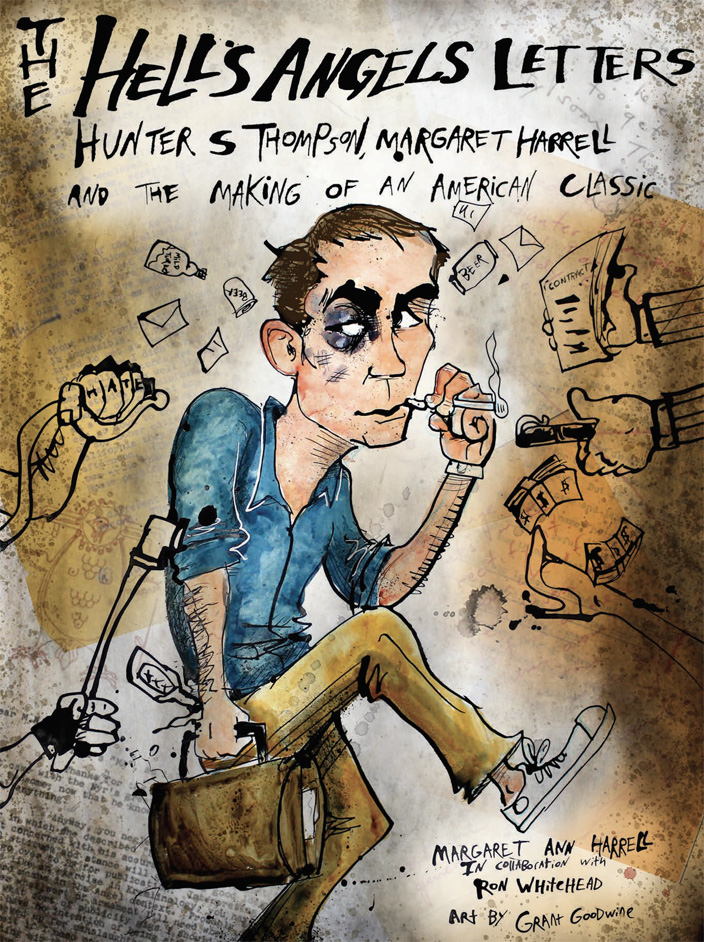
The Hell’s Angels Letters: Hunter S. Thompson, Margaret Harrell and the Making of an American Classic

By Margaret Harrell

I was honoured to recently contribute an essay to this fascinating new book by Margaret Harrell, alongside William McKeen, author of the excellent Thompson biography Outlaw Journalist, and Pulitzer Prize winning journalist David Streitfeld, author of Hunter S. Thompson: The Last Interview. I will be posting more about my experience working with Margaret on this and about the book itself but for now here is a description from the publisher, Norfolk Press, followed by a blurb I contributed to the back cover and most importantly, the link to where you can buy a copy.

Take note, this is a large A4 full colour book and is heavy, hence the price.

From the publisher – “The Hell’s Angels Letters: Hunter S. Thompson, Margaret Harrell and the Making of an American Classic is an important revelation in the legacy of Thompson, with letters that survived precarious shipping and travel over decades, cloaked away from the public. “If Hell’s Angels hadn’t happened I never would have been able to write Fear and Loathing in Las Vegas or anything else . . . I felt like I got through a door just as it was closing,” Hunter told Paris Review. When he secured a hardcover contract with Jim Silberman (Random House), the known part of the story breaks off. To whip up the final edits, Margaret A. Harrell, a young copy editor/assistant editor to Jim, was—in a break from the norm—given full rein to work with him by expensive long-distance phone and letter. This galvanizing action led to a fascinating tale. She uses the letters to resuscitate the cloaked, suspenseful withheld drama. The book peaks in their romantic get-together at his ranch twenty-one years after they last met, a moving tie maintained over the years. What happens, then? Read on and see.”

The Hell’s Angels Letters: Hunter S. Thompson, Margaret Harrell and the Making of an American Classic reveals an oft-overlooked side of Hunter S. Thompson – that of the serious writer and journalist dedicated to his craft and determined to reveal the truth to his audience, no matter the cost. The correspondence covers a pivotal moment in Thompson’s career, on the cusp of making his literary impact as part of the New Journalism movement while simultaneously moving towards realizing his Gonzo persona and style. The letters here reveal the painstaking task of bringing Hunter’s vision to fruition, and Margaret Harrell played an integral role in this journey. – Dr. Rory Patrick Feehan

Buy a copy from the publisher here.

An inside look at how sports shaped Hunter S. Thompson’s ‘gonzo’ journalism

Hi folks,

Really enjoyed reading this overview of how sports shaped Hunter as a writer. I had a chat with the author Bill Shea and he included a quote of mine in the piece.

“One longtime observer of Thompson’s career is Rory Patrick Feehan, a gonzo scholar who may be the only person in the world with a doctorate (from Ireland’s University of Limerick) focused on Thompson.

“The influence of his sports writing background is evident across his entire oeuvre, fostering his love of action verbs and rollicking energy charged narratives that pulled you into the story,” Feehan wrote of Thompson in an email. “Much of that skill was honed during his military days when he had to make even the dullest football game sound exciting, not to say the least for his reporting on bowling in Puerto Rico. It also transferred particularly well to his political journalism – he essentially saw it as a form of sports and wrote about the campaign trail as though it were football season. Rival candidates, underhand tactics and killer blows in the final stretch – that all began with Hunter’s love of sports.””

You can read the full article here 

Rory

Hunter S. Thompson & The 21st Century. A Discussion With Hunter S. Thompson Scholar Dr. Rory Patrick Feehan

67288752_10100160165309831_7236638423354703872_o

Had a great time on the Edge of Reality podcast with Charles Rivers recently. We talked everything from how and why I did a PhD on Hunter, Hunter’s legacy, the state of American politics and more.

It was a lot of fun. Click the player below to listen.

Interview with Genevieve Walker for GQ Magazine

Had a really enjoyable chat with Genevieve Walker of GQ Magazine before Christmas for an article that she was writing about how Louisville is embracing Hunter’s legacy. We talked for almost two hours and the article turned out great. I am quoted a few times throughout and it was a strange feeling seeing my name in GQ Magazine!

Here’s a snippet of the article where I am quoted, for the full article click the link below the extract:

When Dr. Rory Feehan, a Hunter S. Thompson scholar based in Limerick, Ireland, visited Louisville for the first time this year, he noticed an absence of permanent public embrace of Thompson. “Why don’t they have a boulevard or street named after him? He’s an icon. This great writer is part of the cultural heritage of Louisville.”

This year’s GonzoFest kicked off with an evening at the museum on the 19th of July (a day after Thompson’s birthday). The festivities included a panel discussion between Juan Thompson and Whitehead, moderated by WFPL President Stephen George. The Curator, Erika Holmquist-Wall, gave a gallery talk alongside Dr. Rory Feehan.

Flying into Louisville for the first time, Feehan said, “I saw that flat, green land. It was like Ireland in the sun.” Not unlike Kentucky, said Feehan, Ireland is known for whiskey and horse racing. Not unlike Louisville, Dublin had a contentious relationship with its own James Joyce, who is now very celebrated.

Thompson died over a dozen years ago, which for a historian, is no time at all. Already, though, there has been significant renewed interest and engagement with Thompson’s work. “In the last 15 years there has been an explosion of research papers,” said Feehan. As the Gonzoville movement builds momentum and academics fine-tune theories, reframing Thompson’s situation in literature, it makes sense to start defining his place in his hometown, too.

The goal, said Whitehead, is to have a permanent place for all things Hunter S. Thompson. A place that can showcase, and maintain, all of his personal archives.

There are many parties interested in the Thompson archives, and where they’ll eventually come to rest. (Johnny Depp owns a portion.) Will a multi-million dollar facility, like the Muhammad Ali Center, ever be built for them in Louisville? Right now it seems unlikely. But, as Lindenberger said, “If anybody can do it, Ron would pull it together.”

Ron Whitehead—the Outlaw Poet, as he calls himself—will be 69 years old this November. He cares deeply about Thompson’s work, and giving him his proper due in Louisville. He’s also ready to pass the torch. “I’ve been doing this for 25 years,” said Whitehead. “Juan [Thompson] has moved to town. I’m turning this all over to him. Everybody knows that I’m going to stay on top of whatever is going on. I’ll work behind the scenes, but 25 years is enough. This is an ending and a beginning.”

To read the full article on GQ.com click here

Media Coverage from Gonzofest 2019

Hi All,

Well what can I say, Gonzofest 2019 was an absolutely amazing experience. I’m still recovering from the experience and have loads of things to share. First up I just want to share a few links to some media coverage of the event, with particular thanks to Laurel Deppen of the Louisville Courier Journal who interviewed me at Gonzofest.

All the best,

Rory

Gonzofest

Onstage at Gonzofest with thanks to photographer Jeffery Parrish

6 things you didn’t know about Hunter S. Thompson’s life in Louisville

He was arrested — and left Louisville

In 1955, Thompson’s senior year of high school, he was charged as an accessory to robbery and served 31 days in the Jefferson County Jail. Because of this, he missed his final examinations and wasn’t allowed to graduate.

Thompson’s childhood was always split between his literary side and his “juvenile delinquent side,” said Rory Feehan, a Thompson scholar.

“These two competing sides really shaped Hunter Thompson,” Feehan said. “Of course, inevitably, one side got him into a whole heap of trouble. That incident where he was arrested … is probably the most formative episode of his career — his life. It really is. That left such a mark on his psyche.”

To leave Louisville, Thompson joined the Air Force.

He’s a Kentucky Colonel

In December 1996, poet Ron Whitehead produced a tribute event to honor Thompson’s work. There, Thompson was named a Kentucky Colonel, a title that recognizes achievements and service to the community, state and nation, according to its website.

Thompson would only accept the title if actor Johnny Depp, his friend who played him in  1998’s “Fear and Loathing in Las Vegas” and again in 2011’s “The Rum Diary,” received the title as well. Depp was born in Owensboro.

The pair’s Kentucky roots contributed to their bond. Feehan said Thompson was able to trust Depp because they were from the same “neck of the woods.”

After they received the titles, Thompson insisted on referring to Depp only as “Colonel Depp,” Feehan said.

“He wouldn’t do that kind of thing if he didn’t want to be associated with the culture here, so he was proud of it. He had issues with it, but he was proud of it,” Feehan said.

Click here to read the full article


The ‘Year of Gonzo’ is Louisville’s love letter to Gonzo journalist Hunter S. Thompson

Today, there is a growing and renewed literary interest in Thompson’s most iconic works, not just his caricature, according to Rory Feehan, a Thompson scholar who holds a doctorate of English language and literature.

“He is an icon,” Feehan said. “He revolutionized journalism. Tom Wolfe called him one of the greatest comic writers of the 20th century, kind of the counterculture’s Mark Twain, and I just think that Hunter didn’t quite get the recognition he deserved, which is understandable in a way because of the character.”

That’s changing today as his work is becoming more mainstream — something the author might have actually hated. 

The Speed Art Museum exhibit on Thompson focuses on the years between 1965 and 1974, when Thompson wrote some of his most notable work, including “Fear and Loathing in Las Vegas” and “Hell’s Angels.” Both Thompson’s words and the visuals that accompanied them remain relevant and timely nearly 50 years later, said Erika Holmquist-Wall, curator at the Speed, 2035 S. 3rd. St.

“I think visitors will hopefully come away with a better understanding or want to come back and revisit (Thompson’s work) and really read what he was writing and get a sense of what he was trying to achieve: calling out American culture and counterculture at the time,” Holmquist-Wall said.

Revisiting the work nearly 50 years later begs the question of what Thompson would write about American culture today, Holmquist-Wall said.

“We can only surmise,” she said. “I think it would be equally no holds barred.”

Feehan said it’s a pity Thompson is no longer alive to write about what Feehan says is the “outrage age.”

“I’ve often been thinking lately about what would Hunter be like on Twitter,” Feehan said. “What would a 4 a.m. Twitter back-and-forth between Hunter and Kanye West be like? Or Donald Trump?”

Click here to read the full article

DSCF5449

DSCF5474

Speaking at the Speed Art Museum Exhibit with thanks to photographer Jeffery Parrish

This new summer exhibit honors the legacy of Hunter S. Thompson

This summer, the Speed Art Museum will present an exhibition centered around one of Kentucky’s most famous exports, writer Hunter S. Thompson. A lynchpin in the world of modern investigative journalism, Thompson’s approach to reporting would not only lead to the creation of the unique “Gonzo” style but would serve to change his medium forever. Gonzo! will take a closer look at the professional and personal collaborations that Thompson enjoyed with the artists and photographers who were tasked with illustrating his work and articulating his unique voice through visual means.

By narrowing the scope of the exhibition to the decade between 1964 and 1974, Gonzo! will track the peak of Thompson’s rise to success from his first major independent work in long-term investigative reporting, Hell’s Angels: The Strange and Terrible Saga of the Outlaw Motorcycle Gangs, to his sardonic analyzation of the Nixon campaign, Fear and Loathing on the Campaign Trail ’72. The works produced within that decade led to the Thompson’s development of Gonzo journalism – a subjective, socially critical, participatory style of writing that helped to define the American cultural and political landscape of the late 1960s and early 1970s.

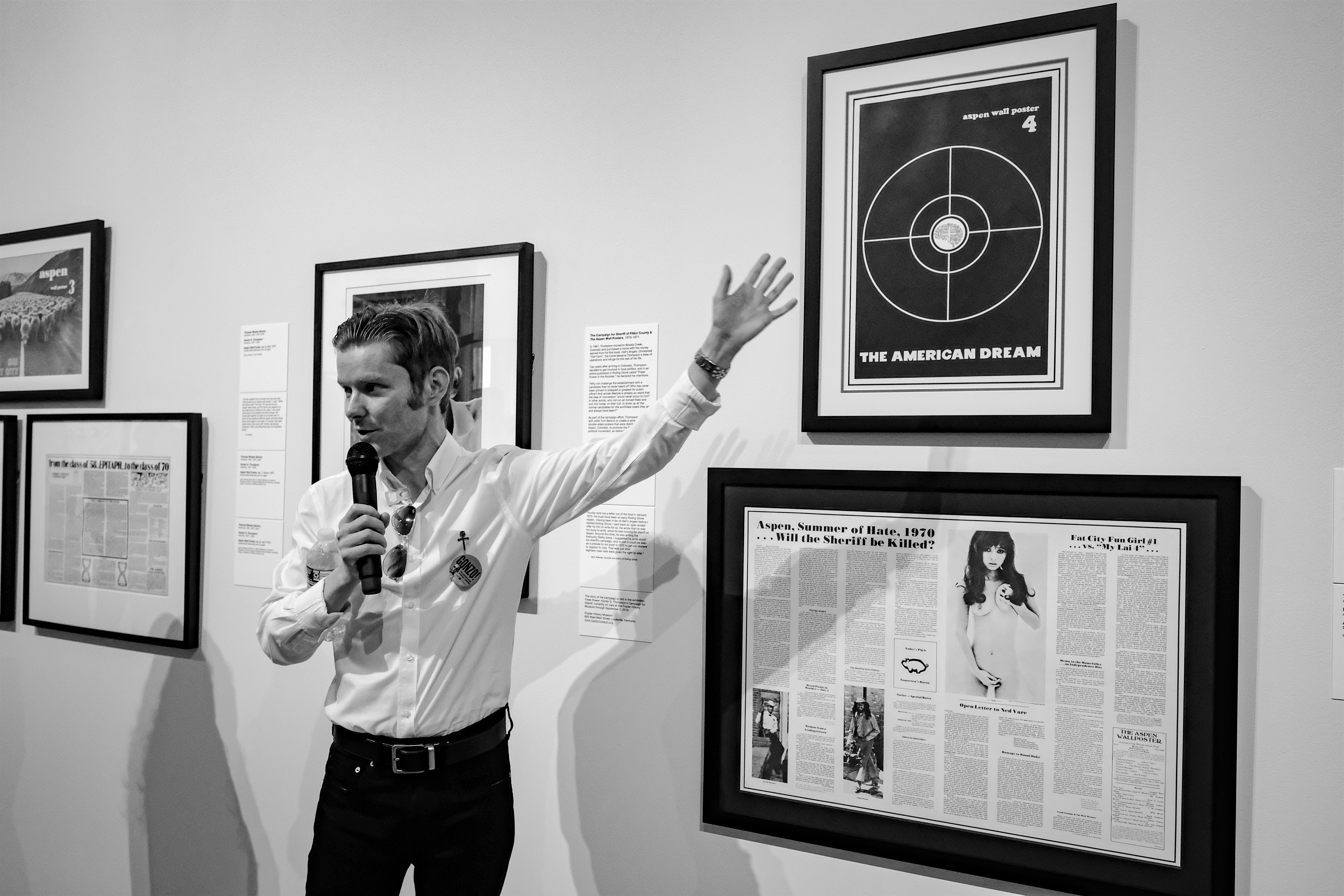
Gonzo! An Illustrated Guide to Hunter S. Thompson is the last of three “Gonzo”-related exhibitions taking place in central Kentucky as part of the Year of Gonzo. The first, Ralph Steadman: A Retrospective, was on view at the University of Kentucky Art Museum until May 5, while the second, Freak Power: Hunter S. Thompson’s Run for Sheriff, is currently on view at the Frazier History Museum. Those who visit all three exhibitions and retrieve a novelty pin from each will receive a custom designed notebook.

In celebration of the exhibition’s beginning, the Speed Art Museum is partnering with GonzoFest Louisville, the annual literary and music festival honoring Hunter S. Thompson.  The Museum’s monthly After Hours @ the Speed event on July 19 will serve as the official kick-off for the festival, featuring a panel conversation between Hunter’s son, Juan Thompson, Kentucky author Ron Whitehead, moderated by WFPL President Stephen George, as well as a gallery talk with Curator Erika Holmquist-Wall and Hunter S. Thompson scholar, Dr. Rory Feehan, and live music highlighting the songs of Thompson’s most prolific decade.

Buy the ticket, take the ride – Gonzo! An Illustrated Guide to Hunter S. Thompson opens at the Speed Art Museum on July 12, 2019 and will close on November 10, 2019. 

Click here to read the full article


Site Redesign

Hi all,

The site is currently undergoing a major overhaul. During this period you may find that numerous site elements are missing or not working (links etc)

The old design served me well for over 10 years (can’t believe how fast that went) during which the site grew from very humble beginnings to over 1 million visitors.

I hope you bear with me while I work on a new design. In the meantime, you can still follow me on Facebook, Twitter and Instagram.

Thank you!

Rory

Upcoming Publication

9781440854859


Delighted to contribute a chapter on Hunter S. Thompson to this forthcoming two-volume set which will be published in October 2019.

From the publisher:

This two-volume set surveys the profound impact that political humor and satire have had on American culture and politics over the years, paying special attention to the explosion of political humor in today’s wide-ranging and turbulent media environment.

Historically, there has been a tendency to regard political satire and humor as a sideshow to the wider world of American politics—entertaining and sometimes insightful, but ultimately only of modest interest to students and others surveying the trajectory of American politics and culture. 

This set documents just how mistaken that assumption is. By examining political humor and satire throughout US history, these volumes not only illustrate how expressions of political satire and humor reflect changes in American attitudes about presidents, parties, and issues but also how satirists, comedians, cartoonists, and filmmakers have helped to shape popular attitudes about landmark historical events, major American institutions and movements, and the nation’s political leaders and cultural giants. Finally, this work examines how today’s brand of political humor may be more influential than ever before in shaping American attitudes about the nation in which we live.

FEATURES

  • Documents the history of political humor in the United States in all of its many forms, with the bulk of coverage weighted toward contemporary political satire and satirists
  • Covers writers, cartoonists, radio personalities, television and movie performers, and internet celebrities
  • Profiles influential television programs, movies, and other forms of entertainment that have made their mark on American politics and culture
  • Includes a chronology of events


Many thanks to Jody Baumgartner for affording me this opportunity.

Rory